The Airport Bottom Line Is Hidden in the Passenger Journey
Industries Jeffrey BaezKey takeaways
- Connect data across the passenger journey to reduce delays, improve operations, and create better travel experiences.
- Use connected operational, commercial, technology, and security data to uncover revenue opportunities and make faster decisions.
- Measure the impact of airport operations and investments to strengthen resilience, improve performance, and support long-term growth.
Airports are no longer just transportation hubs. They are regional economic engines, commercial marketplaces, public infrastructure assets, digital businesses, and critical services organizations operating under constant pressure.
For airport executives, the question is no longer simply, “How many passengers moved through the airport?”
The better question is:
How efficiently did those passengers move, how much revenue opportunity was captured, and how much was lost to friction?
That is where Splunk can create measurable business value.
Airport Growth Is Creating a New Operating Challenge
Air travel demand continues to grow, and that growth brings opportunity. More passengers means more parking revenue, more food and beverage sales, more retail spend, more advertising value, more transportation activity, and greater regional economic impact.
But growth without visibility creates congestion.
Passengers get stuck at the curb. Parking demand spikes before operations can react. Security lines stretch longer than expected. Gate changes create confusion. Baggage delays frustrate arriving travelers. Concession operators miss peak demand windows. Restrooms, escalators, elevators, Wi-Fi, payment systems, and digital signage become part of the passenger experience whether airport leadership planned for it or not.
Every one of these moments has a business impact.
A delayed traveler is not browsing retail. A stressed family is not sitting down for a meal. A passenger racing from security to the gate is not spending money in the terminal. A congested curb creates safety concerns and damages the airport’s reputation. A failed payment system or network outage can quietly suppress revenue during the busiest part of the day.
The modern airport does not have a lack of data. It has a lack of connected answers.
The Hidden Revenue Problem: Friction Reduces Spend
Airports have invested heavily in terminals, parking, concessions, mobile applications, security partnerships, and passenger amenities. Yet many still operate with fragmented views of the journey.
Commercial teams may understand sales by tenant. Operations teams may understand checkpoint wait times. Parking teams may understand garage occupancy. Facilities teams may understand escalator uptime. Public safety may understand incidents. Cybersecurity may understand system risk. Airlines may understand flight disruption.
But the passenger experiences all of it as one journey.
When those data sets remain disconnected, airport leadership loses the ability to answer the most important business questions:
- Which operational bottlenecks are reducing passenger dwell time?
- Where are long lines suppressing food, beverage, and retail revenue?
- Which gates, concourses, or terminal areas are underserved during peak flight banks?
- How do parking conditions affect arrival patterns and checkpoint congestion?
- How much commercial opportunity is lost during irregular operations?
- Which technology outages create the greatest passenger and revenue impact?
- Which capital projects are improving throughput, satisfaction, and spend?
Splunk helps airports move from isolated reporting to operational intelligence.
Splunk as the Airport Decision Layer
Splunk is uniquely positioned to help airports because it can bring together machine data, application data, infrastructure telemetry, security events, operational logs, sensor data, APIs, partner feeds, and business data into a searchable, real-time platform.
For an airport, that could include:
- Flight information systems
- Airport operational databases
- Parking systems
- Roadway and curbside sensors
- Passenger flow analytics
- Wi-Fi and mobile app telemetry
- Point-of-sale data
- Concession performance data
- Baggage systems
- Building management systems
- HVAC, escalator, elevator, and facilities data
- Digital signage systems
- Access control and identity systems
- Cybersecurity tools
- Network and application performance data
- Weather feeds
- Airline, TSA, ground transportation, and public safety data
The value is not merely collecting the data. The value is connecting it in a way that helps airport leaders make faster, better decisions.
Splunk can help an airport understand what is happening, why it is happening, what business outcome is at risk, and which team should act.
Ultimately, how resilient was the airport while it happened?
Use Case 1: Passenger Flow and Revenue Leakage Analytics
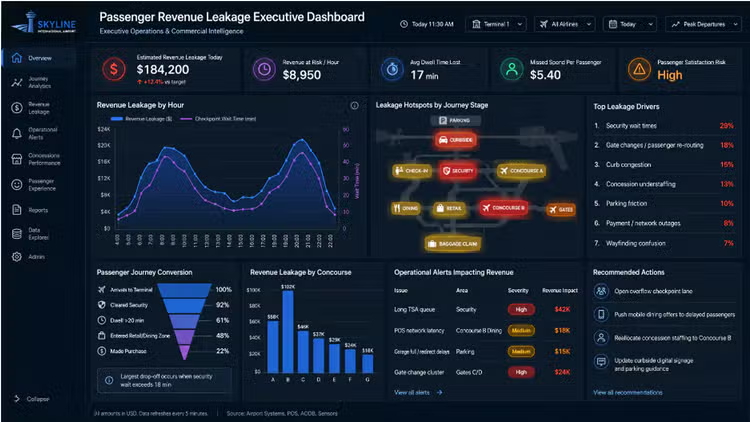
One of the most valuable airport use cases is measuring where passenger friction turns into lost revenue.
Imagine a dashboard that shows not only TSA wait times, but the business consequence of those wait times. If security lines increase by 20 minutes during a peak departure bank, Splunk can help estimate how much post-security dwell time is being lost and which concessions are most likely to be affected.
This creates a new executive metric: Passenger Revenue Leakage.
Instead of viewing congestion as only an operational inconvenience, the airport can quantify it as a commercial issue. That allows leadership to prioritize investments in staffing, queue management, wayfinding, digital communications, checkpoint coordination, and terminal design based on revenue protection.
Use Case 2: Dwell-Time Optimization for Shopping and Dining
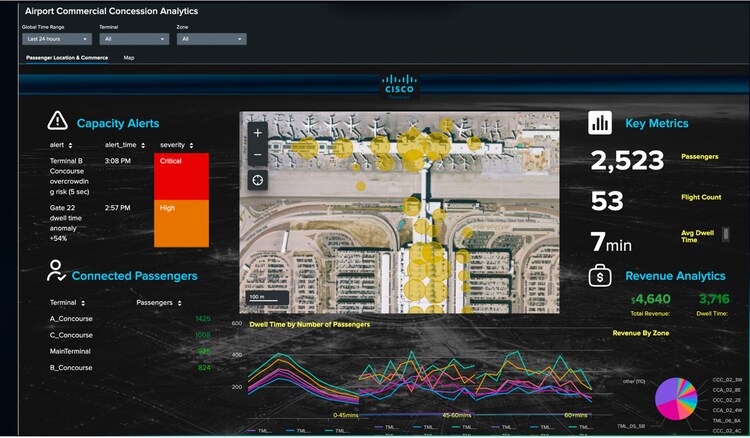
Airport concessions succeed when passengers have time, confidence, and convenience.
Splunk can help correlate passenger flow, flight schedules, gate assignments, wait times, concession sales, mobile order activity, and terminal occupancy to identify where revenue is being captured or missed.
For example, an airport could discover that one concourse has strong passenger volume but weak food and beverage conversion because travelers are arriving too close to boarding. Another area may have high dwell time but poor retail performance due to tenant mix, signage, or staffing. A third may show strong demand during certain flight banks but recurring payment or network issues at peak times.
With Splunk, concession strategy becomes data-driven. Airport executives can use real operational evidence to improve tenant performance, optimize leases, support RFP decisions, adjust hours, improve staffing, and increase spend per passenger.
Use Case 3: Curb, Parking, and Ground Transportation Intelligence
The passenger journey often begins before the terminal door.
Curb congestion, parking constraints, rideshare surges, shuttle delays, and roadway incidents can shape the traveler’s entire perception of the airport. They can also affect revenue. If parking is difficult, travelers may shift behavior. If the curb is congested, dwell times increase, safety risks rise, and passenger stress begins before check-in.
Splunk can unify parking occupancy, license plate recognition data, garage transactions, shuttle telemetry, roadway sensors, rideshare activity, flight schedules, weather, and event data to help airports anticipate demand before congestion becomes visible.
This gives airport leadership the ability to move from reactive traffic management to predictive ground access operations.
The outcome is better use of parking assets, improved curb throughput, safer terminal frontages, better passenger communication, and stronger revenue capture.
Use Case 4: Irregular Operations Command Center
Weather, airline disruptions, air traffic constraints, crew issues, security events, and technology outages can all create cascading impacts across the airport.
During irregular operations, the airport needs one version of the truth.
Splunk can help create an integrated command center that correlates flight delays, gate changes, passenger volumes, baggage impacts, concession demand, staffing, facilities issues, IT system health, public safety events, and passenger communications.
The goal is not just situational awareness. The goal is coordinated action.
If a wave of delayed flights will create extended terminal dwell time, concessions can staff accordingly. If a gate change will move hundreds of passengers across the terminal, digital signage and mobile messaging can respond. If baggage delays are forming, customer service and airline partners can be alerted. If a critical application or network service is degrading, IT and cyber teams can see the operational impact immediately.
Splunk helps airport leaders reduce disruption, protect customer experience, and preserve revenue during the moments that matter most.
Use Case 5: Cyber-Physical Resilience
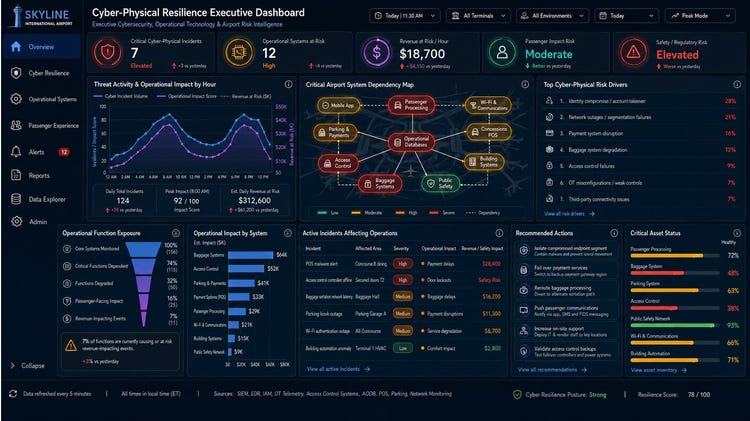
Airports are digital environments. Passenger processing, parking, payments, baggage, building systems, access control, communications, Wi-Fi, mobile apps, operational databases, and public safety systems all depend on technology.
That means cyber risk is now operational risk.
A cybersecurity event at an airport is not just a technical issue. It can become a passenger experience issue, a safety issue, a revenue issue, a regulatory issue, and a reputational issue.
Splunk can help airport CISOs and technology leaders connect cybersecurity telemetry with operational impact. Instead of viewing alerts in isolation, teams can understand which systems support critical airport functions and which incidents could affect passenger movement, payment processing, concessions, baggage, facilities, or public safety.
This is where the CIO, CTO, and CISO agenda converges with the airport executive agenda: resilience.
The airport must stay operational, secure, and trusted.
Use Case 6: Capital Planning and Performance Measurement
Airports are making major infrastructure investments to accommodate future growth. Terminal expansions, parking improvements, roadway changes, baggage modernization, checkpoint redesign, concession redevelopment, and digital transformation projects all require strong business cases.
Splunk can help airport leaders measure whether those investments are producing the intended outcomes.
Before and after a project, the airport can measure:
- Passenger throughput
- Queue times
- Dwell time
- Concession revenue
- Parking utilization
- On-time operational impact
- Asset uptime
- Incident volume
- Energy performance
- Customer experience indicators
- Technology reliability
- Security posture
This creates a powerful governance tool for commissioners and executive leadership. Capital investments can be evaluated not only by whether they were completed, but by whether they improved the airport’s business performance.
The Executive Outcome: A Smarter, More Profitable Airport
The business value of Splunk for an airport is not limited to security or IT operations.
Splunk can help improve the airport bottom line by enabling leaders to:
- Increase non-aeronautical revenue
- Improve spend per passenger
- Reduce congestion and operational friction
- Improve parking and ground transportation revenue capture
- Protect concession performance during peak periods
- Reduce the cost and impact of disruptions
- Improve asset uptime
- Strengthen cyber and operational resilience
- Improve passenger satisfaction
- Support better capital planning
- Give commissioners and executives measurable evidence of performance
The most important shift is this: Splunk helps airport leaders see the airport as an interconnected business system.
A queue is not just a queue. It is lost dwell time.
A parking spike is not just a parking event. It is a predictor of terminal congestion.
A delayed flight is not just an airline issue. It is a staffing, concessions, baggage, customer experience, and communications issue.
A cyber alert is not just a security event. It may be a threat to revenue, safety, and operational continuity.
A technology outage is not just an IT ticket. It may be a disruption to the passenger journey.
Turn Airport Data Into Operational Advantage
Airports are full of signals. Passenger movement, parking demand, curb congestion, payment systems, baggage performance, building systems, cybersecurity alerts, mobile app activity, concession sales, and partner operations all generate data every second.
The opportunity is turning those signals into decisions.
Splunk helps airport leaders connect operational, commercial, technology, and security data into a shared intelligence layer—one that reveals where friction is forming, what business outcome is at risk, and what action should happen next.
For airport executives and commissioners, that means better visibility into passenger experience, revenue performance, capital investment outcomes, and operational resilience.
For CIOs and CTOs, it means a scalable data platform that connects complex systems across the airport ecosystem.
For CISOs, it means understanding how cyber events affect passenger processing, payments, baggage, access control, public safety, and airport operations.
The next step is simple: start with one high-value airport journey.
Choose a priority such as passenger revenue leakage, curb and parking congestion, cyber-physical resilience, baggage disruption, or concession performance. Then bring the right data together and show what Splunk can reveal.
Ready To See What Your Airport Data Is Trying To Tell You?
Connect with a Splunk expert to explore how the Splunk Platform can help your airport improve operational performance, protect revenue, strengthen resilience, and deliver a better passenger experience.
The future of airport performance will belong to leaders who can connect data across the entire journey and turn it into action. To be efficient and resilient in an environment of constant change,
Splunk helps airports do exactly that.
Because the airport bottom line is not hidden in one system.
It is hidden in the journey.
Related Articles

The Insider Threat That Doesn’t Sleep

Monitoring Pulse Connect Secure With Splunk (CISA Emergency Directive 21-03)