Data Doesn’t Have Borders, But You Do: Embrace the Fusion Center for Today’s Digital World
CISO Circle Anthony (Tony) PierceIn today’s hyper-connected world, security teams are experiencing the butterfly effect in real time, but can SOC’s keep pace?
Edward Lorenz, the MIT meteorologist who pioneered chaos theory, argued in his paper “Predictability: Does the Flap of a Butterfly’s Wings in Brazil Set Off a Tornado in Texas?” that tiny changes in one place can trigger massive consequences somewhere else. The same is true of our current world of digitally connected systems.
Super-scaled cloud data centers sit across the globe, so a single misconfiguration, outage, or exploit in one region can bring down systems on the other side of the world. Recent non-malicious events show just how interconnected the world has become. From major cloud DNS outages and fault patch from a cybersecurity company that caused global disruption, to the compromise of trusted network software and a targeted exploit that spread far beyond it’s intended target, these incidents prove on thing: whether international or not, what affects one can quickly affect many. This is the new digital world!
So, how do modern organizations create order from this chaos and stay resilient? To combat events on a global scale you need to have a single pane of glass for the entirety of the business; enter in the global fusion center.
A global fusion center is more than a supercharged SOC. It’s a centralized hub that brings together people, data, processes, and technology from across the business. By breaking down data and business silos and enabling a data-to-outcome approach. Global fusion centers empower organizations to not only respond to threats, outages, and risk no matter where they are or how they arise but be proactive to protect the business as a whole, not just cybersecurity.
The need for fusion center approach
In the digital world, borders are just lines drawn on a map. Data doesn’t care about state lines or regional boundaries. Data is integrated globally, flowing around the world much like water flows across Earth’s surface. Just like water, data can be catastrophic if left unchecked. The butterfly effect was originally developed for weather prediction, but its principles can now help us anticipate global events at scale by shifting from reactive responses to proactive, data-driven strategies. That’s why global fusion centers are so critical in today’s digital world. Just as weather centers monitor conditions worldwide to forecast patterns, fusion centers enable organizations to make holistic, data-driven decisions, tracking not just individual threats but also trends across security, geopolitics, weather, supply chains, and countless other data sources. By connecting these signals, organizations can anticipate risks and protect the business as a whole, no matter where the data resides.
Nations have enacted many governances, regulations, and compliance (GRC) frameworks like GDPR, DORA, NIST, and LGPD in an effort to keep data protected. While these provide guardrails and a way to measure resilient systems, compliance isn’t enough to manage every risk or threat faced by the NOCs, SOCs, and IT Operation Centers that have to contend with the effects of integrated data and continue to drive revenue and deliver services to their customers. This is why the world is moving to the fusion center concept.
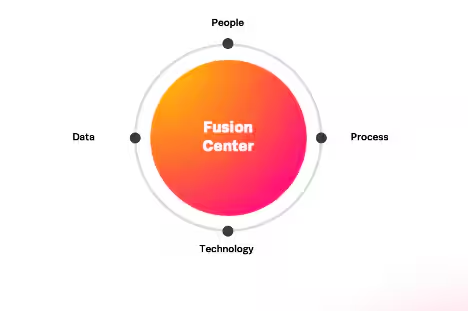
A true fusion center integrates four core elements:
- Data through a complete data matrix incorporating security, IT, OT, IOT, Business Data, and GRC data.
- People from all levels of the business with specific skills that focus on maintaining business integrity. They could include cybersecurity, IT Ops, NetOps, GRC, public relations, business, cyber intelligence, legal and other business critical functions that would need to be activated in the case of an emergency.
- Processes like unified playbooks that simplify the “what now?” question during a major event. These are not only incident response playbooks but rather emergency action plans that includes the entirety of the global organization.
- Technology by using a consolidated orchestration platform that gives a bird’s-eye view of your global data and tech stack. This lets you monitor business critical operations and technology and reduce overall risk. Just like a weather center becomes the single point of Truth for a myriad of data channels so must a GFC have that same scalability.
Anthony Pierce
Fusion centers in action
Sure, a fusion center sounds good in theory, but how does this approach play out in the real world, when stakes matter the most?
A few years after COVID, Los Angeles experienced a series of riots. A top-tier global bank, which continuously monitored social media for trends and key terms, picked up a disturbing signal: people outside the U.S. were encouraging LA residents to “make a statement” by targeting and setting fire to one of the bank’s local branches. Although the monitoring was intended for cyber threats, this activity surfaced as a clear business risk, triggering activation of the bank’s global fusion center.
Once the fusion center lead validated the threat, the teams moved into coordinated action. IT Ops began generating real-time backups of all data systems tied to the branch. NetOps worked to isolate the branch’s network so a physical incident, like a fire, wouldn’t compromise the wider environment. Cyber Ops launched an investigation to determine whether the threat was also a smokescreen for a deeper attack on the bank’s data Systems. Legal teams were alerted to assess potential liability and directed paralegals to begin preparing insurance and notification paperwork. And business customer support quickly drafted emails and letters to reassure affected customers that their funds and data remained safe.
Physical security teams also evaluated response options. While the bank had a rapid-reaction security team ready to deploy, public relations and HR concluded that surrounding the branch with armed guards during a civil rights protest would create unacceptable reputational and safety risk. Instead, physical security shifted into a coordination role with local public safety agencies. Meanwhile, the public relations team began drafting external statements for the media and the public as the threat continued to escalate.
In this moment, the fusion center orchestrated a unified response across technology, operations, legal, customer trust, and brand reputation when every second counts.
In this scenario cybersecurity’s intelligence gathering delivered the first alert. None of the critical responses would have been possible without a data-driven approach and a consolidated view of the entire organization. What’s really interesting is that the initial indicator didn’t come from within the country at all. It originated abroad, where anarchists took advantage of the chaos to strike, not only to shake confidence in the bank and America’s critical banking system, but also to undermine global trust in a U.S.-based company.
Creating a data-driven advantage
In an integrated data world, a single event—a cloud outage, runaway exploit, third-party breach, major storm, or geopolitical decision—can instantly reshape a company’s risk profile. A fusion center keeps pace by applying a data-driven macro view of business risk and unifying formerly siloed teams into one resilient system.
In a cloud provider outage, business intelligence flags the disruption and alerts business units so they can engage customers. Cloud Ops shifts workloads or activates redundant systems. Cybersecurity tightens its posture and monitors for opportunistic attacks, while PR, legal, and other stakeholders gauge reputational and financial impact.
In a major exploit targeting EU accounts, cyber intelligence detects the threat. NetOps isolates affected segments, IT Ops deploys patches, and cybersecurity hunts for indicators of compromise. Public relations, business continuity, and legal prepare to manage public disclosure and regulatory fallout.
This is where people, processes, and technology all generate data points that can be leveraged for better business decisions. A global fusion center connects the dots no matter where the data resides and just like in the weather centers they are prepared to weather the storms of tomorrow. By identifying and recognizing that a small action halfway around the world can trigger cascading events elsewhere. That interconnected digital reality demands more than a reactive response, but a proactive sustainable resilient system which a global fusion center fusion center is built to deliver exactly that.
Subscribe to the monthly Perspectives by Splunk newsletter for actionable executive insights to help secure your business against evolving global threats.