Why Modern CISO Accountability is a Personal Liability
CISO Circle Leonard Wall Senior Executive AdvisorThe modern CISO is no longer just a technologist. Today, their role carries personal legal exposure that many are not fully prepared for, while accountability now extends far beyond individual performance.
Misunderstanding the scope of responsibility, or assuming that good technical execution is enough, can leave CISOs vulnerable to accusations of negligence or misrepresentation. As the role becomes more intertwined with regulatory expectations, leaders must understand not only how to build secure systems but how their decisions will be interpreted within legal and governance frameworks.
How a CISO spends, documents, and reports on their security posture can determine what becomes discoverable in court and how regulators interpret their judgment. What used to be viewed as operational judgment is now being scrutinized as evidence of whether a leader acted reasonably and aligned with legal expectations. In this environment, the difference between diligence and liability often comes down to how spending is categorized, how decisions are communicated, and how well legal counsel was looped into the process. CISOs that fail to do their due diligence in these areas can risk inviting additional scrutiny from auditors, incurring regulatory fines and penalties, and damaging their organization’s brand and reputation in the market — not to mention their own jobs and reputation.
CISOs view legal team as trusted advisors
The relationship between the CISO and general counsel is shifting from an occasional partnership to a structured operating rhythm that underpins the entire security program. Many organizations are establishing a regular cadence of monthly or quarterly working sessions and treating their legal counsel as a trusted advisor throughout the budgetary process. These conversations give legal a clear understanding of the technical landscape and help CISOs ensure that decisions made today can be defended tomorrow.
General counsel is also becoming more involved in shaping the way security communicates internally. CISOs are learning that the tone, precision, and level of detail in documentation can influence how an incident is interpreted under discovery. Legal teams are helping refine reporting templates, escalation notes, and architectural reviews to strike the right balance between operational transparency and legal defensibility. This guidance reduces the chance that well-intended internal conversations later appear reckless or negligent when examined out of context.
This deeper alignment is leading to meaningful changes in how incident response is structured. Legal teams provide advice on when issues become notifiable, how evidence should be preserved, and how communication flows should be sequenced to maintain privilege. As a result, the goal of incident response is not only to contain a threat but to create a coherent and legally sound narrative that reflects diligence and disciplined decision making.
Because of this shift, CISOs are involving legal earlier in decisions that previously sat only within the technical domain. Tool evaluations, architecture changes, tabletop exercises, and even vendor negotiations increasingly have legal present or consulted. This embedded partnership reduces surprises during a crisis and ensures that both security and legal can defend the program with clarity, consistency, and credibility.
Integrating legal counsel into cybersecurity operations
The shift CISOs face in protecting their personal liability is prompting many to maintain a base level of legal expertise, similar to CFOs and other executive counterparts. I also recommend that CISOs take formal courses in corporate liability, regulatory obligations, and board governance so they can navigate the role with a clearer view of personal and organizational risk.
Part of CISOs’ increasing personal risk includes their financial risk. If a CISO has relied heavily on OpEx driven incident response services, they’re often on the hook to produce every invoice, communication, and retainer agreement for the evidentiary record.
Consequently, many security leaders are involving legal teams in budgetary planning and moving key security investments from OpEx to CapEx to contain what becomes visible during litigation. A CapEx purchase can be treated as an asset and is often less vulnerable to discovery requests that focus on the actions taken during a specific incident window.
CISOs who have not updated their procurement and budgeting processes to reflect this reality are often surprised that something as simple as the categorization of a spend can influence the downstream legal narrative. Courts and regulators will always ask whether a leader acted reasonably. When an organization demonstrates that it invested in durable capabilities and controls outside of a crisis, it becomes easier to prove that the CISO fulfilled their responsibility.
In addition to being a technologist and an operational leader, modern CISOs are increasingly expected to hold fiduciary and legal responsibilities . Those who boost their understanding of legal liabilities, while building and nurturing relationships with legal, HR, risk, and the board, are well positioned to withstand the scrutiny that follows an incident, regardless of severity.
Leveraging tabletop exercises to minimize legal liability
Most people don’t know how they’re going to respond in any given situation until they’ve experienced it first-hand. The same holds true for security leaders when facing a security incident or other crisis. But one of the ways CISOs are addressing uncertainty around incidents is with closed door tabletop exercises, intentionally separated from the formal paper trail, aimed at mitigating risk and legal liability.
While tabletop exercises have always been a critical tool in security operations, their character is changing. These sessions still replicate breach scenarios, system failures, ransomware attacks, or insider threats, but they do so in a format that limits discoverability. A small, legally protected circle participates, and documents are managed in ways that do not unnecessarily expand the record. These exercises allow leaders to test uncomfortable scenarios, practice coordinated response, and expose soft spots in communication workflows without creating material that could later be interpreted unfavorably.
Closed door sessions also accelerate alignment between the CISO and general counsel. A major outcome of these exercises is a shared understanding of how the business will make high pressure decisions. When counsel knows in advance how the security team will respond, they can build legal strategies around those expectations. This preparation becomes especially important in ransomware cases or situations where an incident triggers regulatory reporting obligations.
Preparing for the future of CISO accountability
As the role of the CISO evolves, personal liability and organizational expectations are intensifying. Proactive risk management is no longer just a technical imperative—it is a critical component of leadership. To navigate this complex regulatory landscape, CISOs should leverage a defensible framework that demonstrates due diligence through three core strategic pillars:
- Privileged Tabletop Exercises: Move beyond basic scenario planning by conducting closed-door exercises under the guidance of legal counsel. By structuring these sessions to generate privileged, confidential records, CISOs can proactively identify gaps in response plans while establishing a clear evidentiary trail of due diligence that protects both the organization and the individual.
- Operationalized Response Drills: Shift from theoretical validation to hands-on testing of technical controls and escalation procedures. Regularly scheduled, high-fidelity drills ensure that response teams can act with precision under pressure, providing quantifiable evidence of operational readiness and risk reduction.
- Strategic Communication Workflows: Formalize repeatable channels for internal and external information sharing. By predefining roles for communication with the board, regulators, legal counsel, and customers, CISOs can minimize reputational risk and ensure compliance with disclosure requirements, maintaining stakeholder trust during a crisis.
Together, these processes form a robust framework for proactive risk management. By engaging legal counsel early, structuring exercises to protect sensitive information, and maintaining transparent communication workflows, CISOs position themselves to lead confidently amid evolving cyber risks and regulatory scrutiny.
Ongoing education, strategic collaboration, and thoughtful documentation are now essential tools for navigating the current landscape. This approach aligns with the reality that personal liability is rising; those who embrace this mindset will not only protect themselves but also strengthen the resilience and credibility of their organizations.
Subscribe to the Perspectives by Splunk newsletter and get actionable executive insights delivered straight to your inbox to stay ahead of trends shaping security, IT, engineering, and AI.
Related Articles
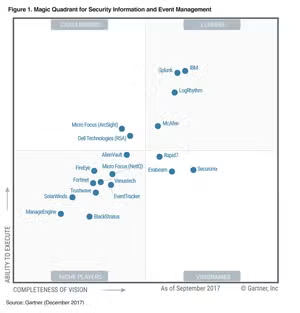
Splunk Named a Leader in Gartner SIEM Magic Quadrant for the Fifth Straight Year

Staff Picks for Splunk Security Reading March 2021