Strong Data Governance, Stronger AI Results
CISO Circle Keith McClellanAI won’t save a siloed company, no matter how advanced your tech stack is. Without shared governance and a culture that values collaboration, silos will quietly undo the best-laid strategies.
Artificial intelligence is quickly becoming the forcing function that compels organizations to take governance seriously. When data is incomplete or fragmented, AI does not just operate less efficiently; it can produce results that are inaccurate, biased, or even risky.
Over the course of my career, I have observed that most organizations naturally create data silos. They don’t form because technology fails; they form because people protect what they know, teams optimize for their own goals, and leadership often underestimates the cost of disconnection. In other words, silos are not just a technical flaw. They are a reflection of human behavior, and leadership sets the tone for change.
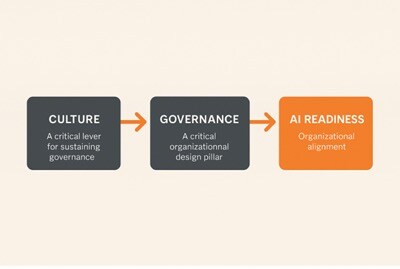
This is where governance and culture meet. Governance provides the structure to share information responsibly, while culture builds the trust that makes people willing to share in the first place. One without the other is ineffective. Together, they create the connective tissue that allows AI to operate on a full and accurate picture of the business. AI can amplify the value of data, but it can also amplify mistakes and inefficiencies if working from incomplete data due to fragmented data environments.
Strategic value of governance in AI-driven organizations
Many enterprises rely on distributed, cloud-based infrastructures where data lives in separate systems with limited context. Introducing AI into that kind of environment exposes just how disconnected data really is.
Governance is often perceived as red tape, but it can and should be a strategic enabler of innovation. A well-structured governance process provides value to participants by reducing inefficiencies and improving data quality. For example, in IT environments where application teams provide logs to a central platform, clear governance ensures proper permissions, retention policies, and data formatting. This prevents costly misalignments and ensures data is available for analysis.
In my experience, the most common governance failures occur not from a lack of rules but from outdated or overly complex ones. Rules are often created in response to past failures and remain unchanged long after their original purpose has expired. Overly rigid governance can hinder innovation and fail to address current challenges.
Proper governance should be a living system that evolves alongside technology and organizational needs. With AI, outdated rules can block access to valuable data, reducing the return on investment for AI initiatives. Revising governance to reflect current capabilities and requirements is essential for maintaining both compliance and operational effectiveness.
A modern governance framework begins with a one-team mindset. Political infighting undermines governance initiatives, so alignment around a common purpose is critical. Executives should start by assessing the data landscape, understanding the types of data being generated, and identifying critical integrations. Machine data, business data, and sensitive personal information all have different requirements.
Understanding this landscape informs decisions on repository consolidation, access permissions, and AI integration. Consolidating around fewer repositories and design patterns reduces costs and simplifies governance, while enabling more effective AI deployment.
Shaping a culture that reinforces governance
Culture is another critical lever for sustaining governance. Leaders play a central role in modeling the behaviors that promote cross-functional collaboration. Transparent communication and visible support for governance initiatives signal to the organization that data sharing is a priority. Leadership alignment creates momentum and reduces resistance to change, while lack of clarity or inconsistency allows silos to persist.
Driving cultural adoption also requires clearly defined structures and accountability. Establishing committees to set and update governance rules, approve exceptions, and guide integration across teams ensures consistency. These groups should include representatives from key functions such as IT, data management, business units, and compliance, while keeping the group focused enough to make timely decisions. Integrating governance responsibilities into existing workflows, such as architecture reviews and change management processes, embeds accountability into daily operations and reduces redundancy.
When teams understand who is responsible for rules, decisions, and exceptions, they are more likely to follow governance processes and share data effectively. Conversely, diffusing responsibility across multiple teams creates confusion and undermines adoption.
Well-designed governance also enables innovation. The goal is not to control behavior but to provide teams with structured access to the right data, empowering informed decisions and faster collaboration. When governance is aligned with organizational objectives and reinforced by executive behavior, it reduces friction, drives cross-functional collaboration, and maximizes the value of data.
Real-world governance lessons for responsible AI implementation
Across industries, I’ve seen that the organizations most successful with AI share one common trait: they treat governance as a design principle, not an afterthought. In financial services, for example, leaders are creating “data councils” that bring compliance, analytics, and product teams together to approve data usage models before deployment.
This cross-functional approach prevents bias, accelerates regulatory approval, and ensures transparency throughout the AI lifecycle. In the public sector, we’re seeing similar success where open-data frameworks and standardized APIs allow agencies to share insights securely while maintaining privacy and oversight.
The throughline in each case is intentional design. Governance is embedded into the systems, not layered on top of them. Policies are translated into automated controls like access permissions, data lineage tracking, and audit logging, that operate seamlessly in the background. This reduces friction for end users and ensures that compliance happens by default, not by exception.
Building the future of AI responsibly requires the same mindset.
Leaders must architect governance as a living framework that evolves with technology and business priorities.
This means regularly reviewing rules for relevance, simplifying where possible, and integrating new risk-assessment criteria for AI models and data pipelines. It also means empowering governance committees to make data-driven adjustments quickly when conditions change.
When governance is proactive, adaptive, and embedded into culture, it becomes the mechanism through which organizations scale AI safely and confidently.
Turning governance alignment into actionable AI strategies
When governance and culture move in tandem, they create the shared language and accountability that allow strategy, systems, and teams to operate as one. This alignment is what makes complex enterprises capable of scaling responsibly in the age of AI.
The next challenge for most organizations is not defining governance but operationalizing it by turning principles into integrated processes that connect data, tools, and workflows across every function. That is where culture and technology intersect. Governance defines the rules of engagement; integration puts them into motion.
This is where the conversation turns next: how to integrate at scale. How can organizations translate governance and culture into concrete architectures that unify data, reduce redundancy, and align technical decisions with business outcomes? Building that bridge between intent and implementation is the next frontier.
Subscribe to the Perspectives by Splunk newsletter and get actionable executive insights delivered straight to your inbox to stay ahead of trends shaping security, IT, engineering, and AI.
Article Content goes here